Free tools
Open to every VCE student, sorted by subject. Open a subject to see everything in it. More subjects are on the way.
Calculators
For working things out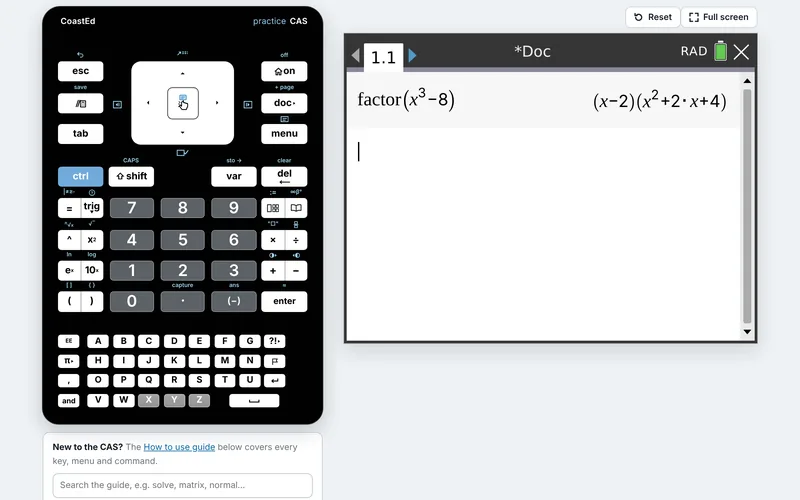
CAS calculator
Solve, factorise, expand, differentiate, integrate and graph in your browser, with exact answers.
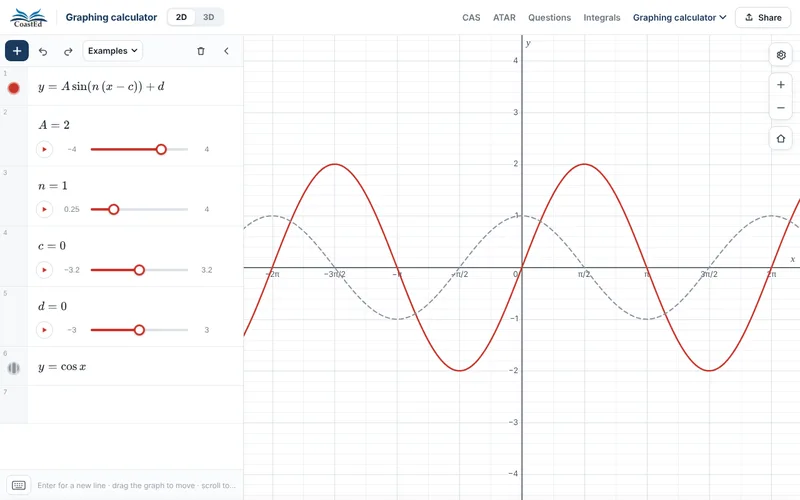
Graphing calculator
Graph functions, equations, inequalities, polar and parametric curves. Add sliders, drag points, and tap a graph for its intercepts, turning points and intersections.
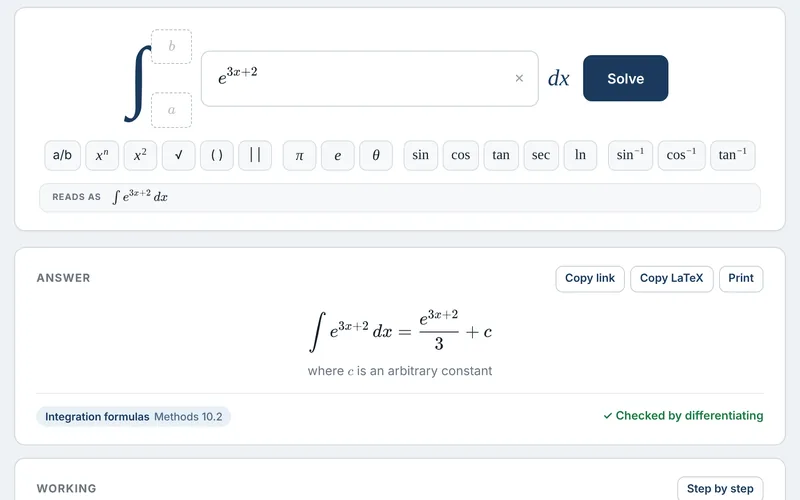
Integral calculator
Type any integral and get full working using only Methods and Specialist techniques, laid out like the CoastEd notes. It tells you when one can't be done by hand.
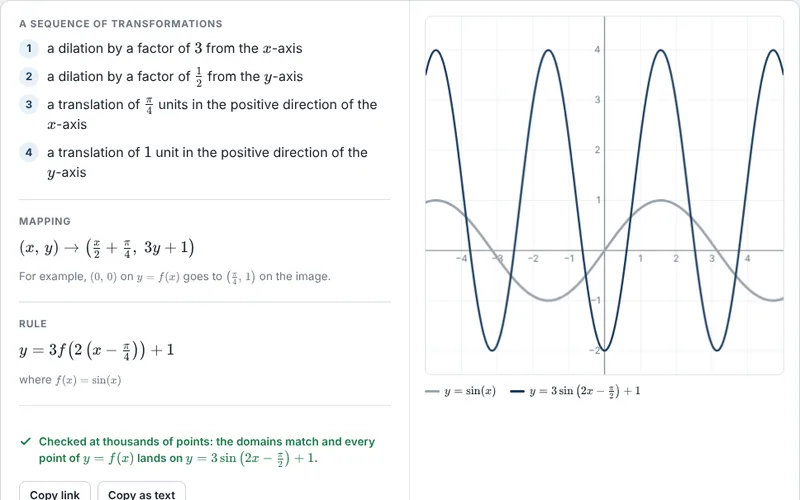
Transformations calculator
Type a graph and its image to get the dilations, reflections and translations between them, worded the way VCAA does, with the mapping and the rule. It tells you when it can't be done.
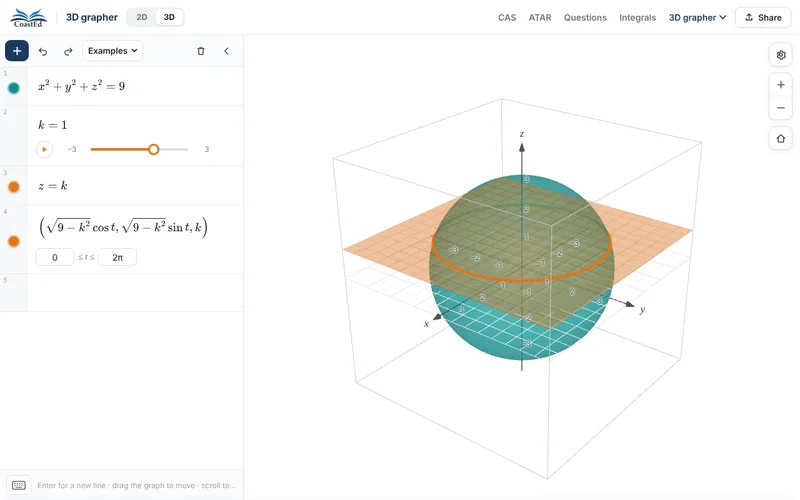
3D grapher
For Specialist: graph surfaces, planes, spheres, vector lines and parametric curves in 3D, then spin them around.
Practice
Fresh questions and quick drills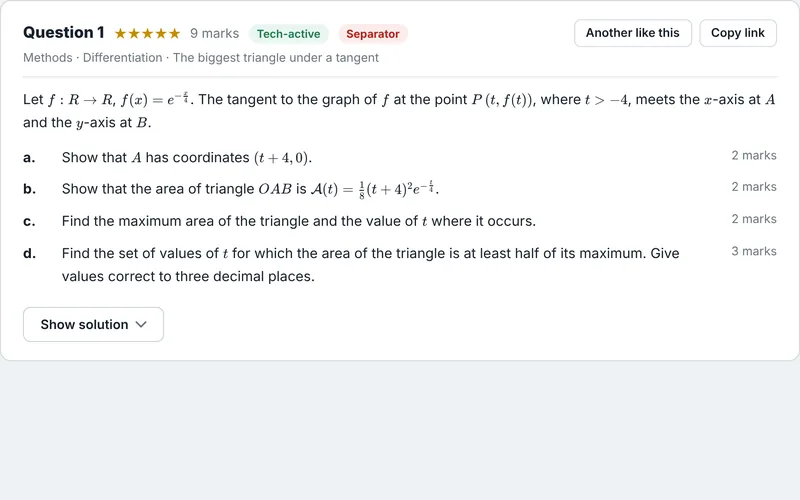
Question & separator generator
Fresh Methods and Specialist practice questions, from the basics to exam separators, with full worked solutions and marks.
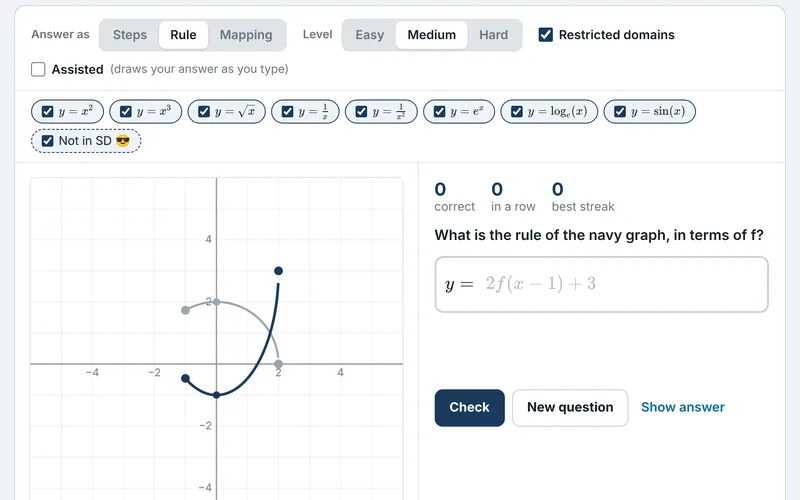
Transformations
See y = f(x) and its image, then describe the transformation: as steps (dilations, reflections, translations), as a rule like 2f(x−1)+3, or in mapping notation.
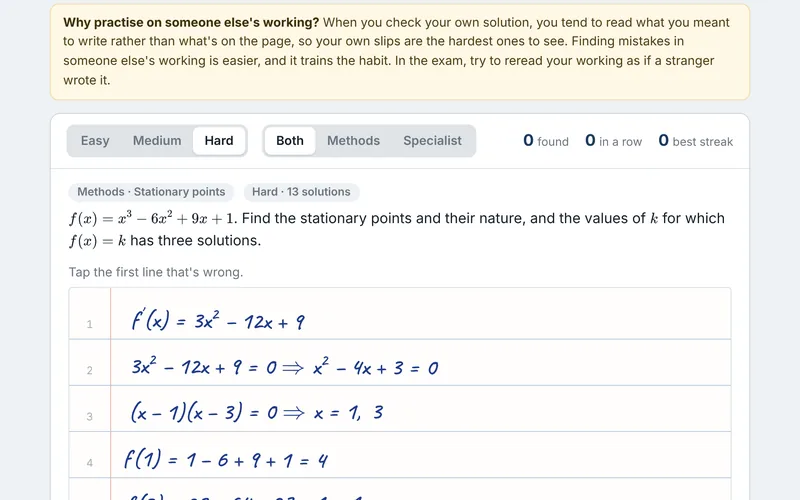
Spot the error
A worked solution in handwriting with one deliberate mistake. Tap the line where it first goes wrong. The mistakes are the ones VCAA examiners' reports flag most, for Methods and Specialist.
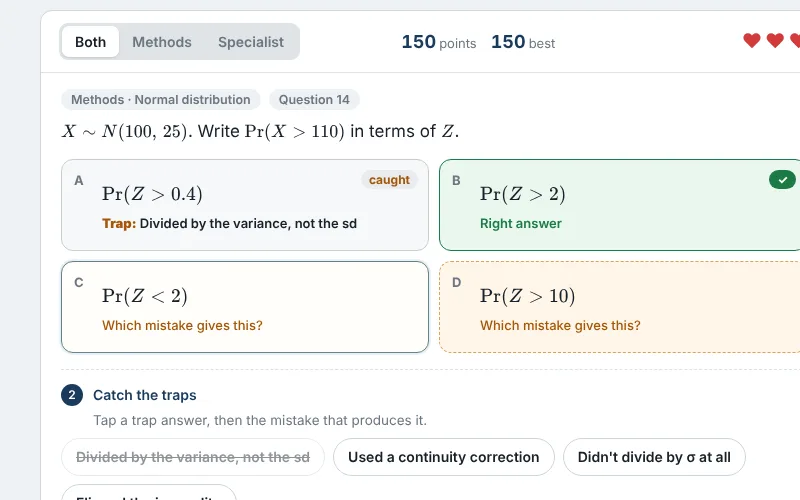
Trap match
Four answers, one right. The other three are what the most common VCE mistakes give you. Pick the right one, then match each trap to the mistake behind it. Three hearts, streak bonuses.
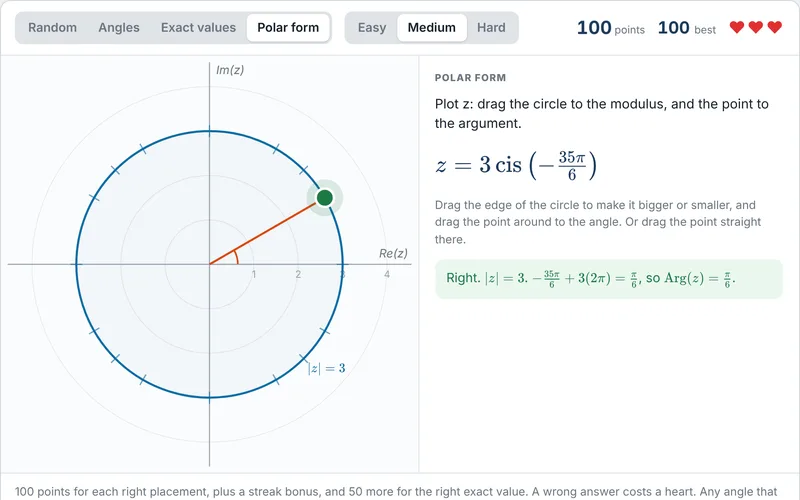
Spin
A unit circle and polar form game. Drag the point to angles like 200π/3 (take off the full turns first), pick exact values, and drag the circle and the angle to plot complex numbers given in Cartesian, cis or exponential form.

Vector golf
For Specialist vectors. Drag vectors onto the ball to sink it: they add tip to tail and work from anywhere. Later holes give magnitude and direction, surd magnitudes and unit vectors you have to stretch.
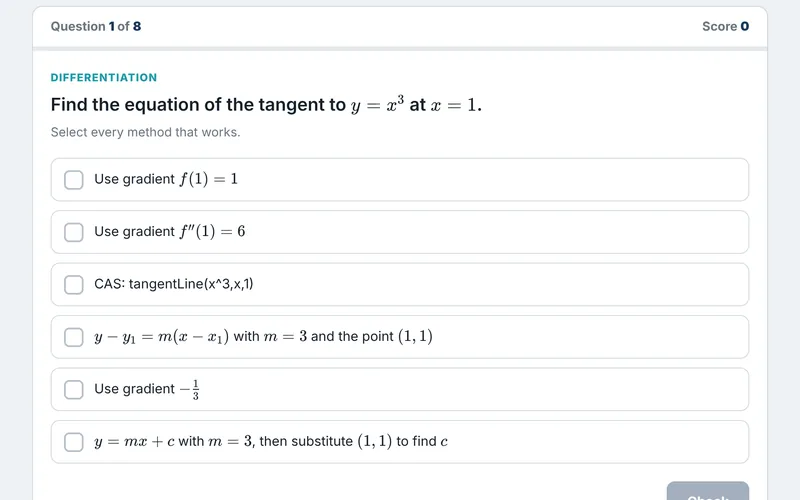
Every way
A game: for each Methods or Specialist question, pick every method that works. Learn the other ways to check an answer, and why the tempting wrong ones fail.
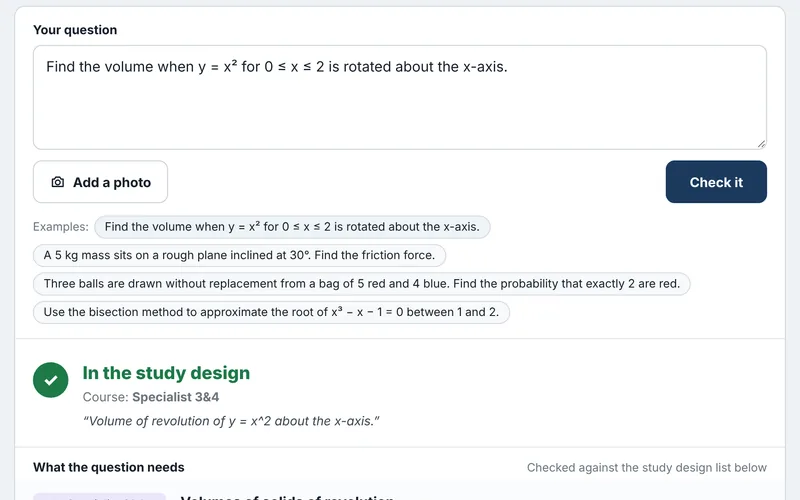
Is it in the study design?
Type a topic or snap a photo of a question to see if it's in Methods or Specialist Units 3&4. Great for old papers and trial exams that go off-course.
Explore
Drag things around and see the maths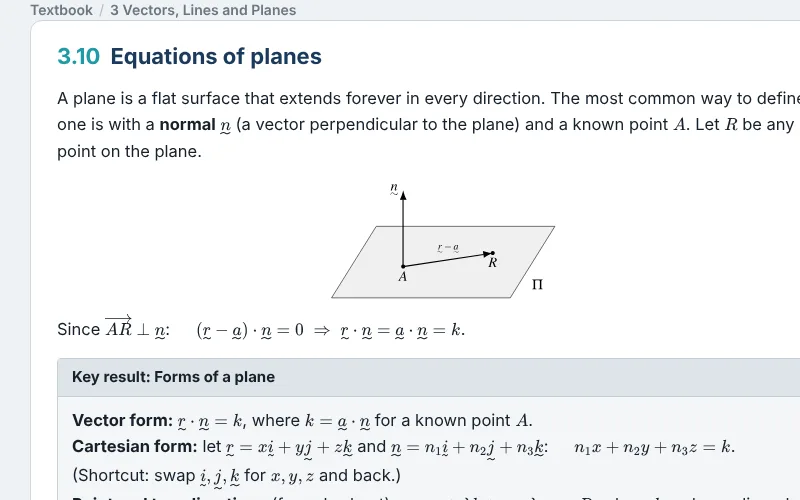
Interactive textbook
The full CoastEd Methods and Specialist notes, one section at a time. Read a section, then try its questions straight away, with full worked solutions.
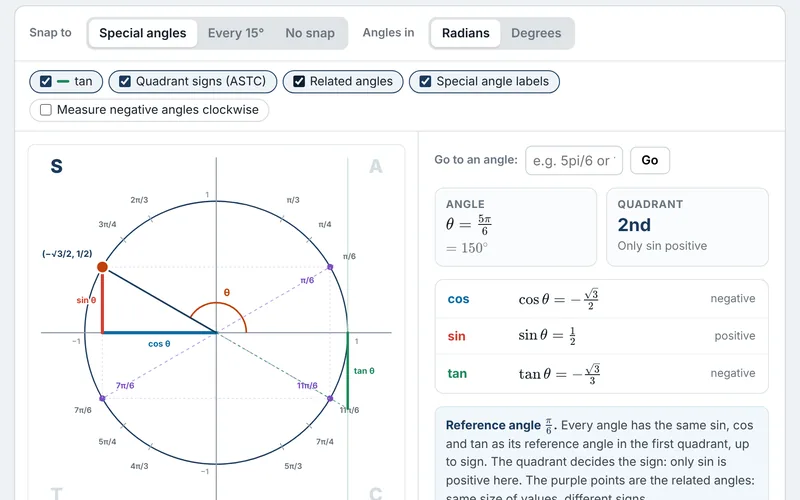
Unit circle
Drag a point around the unit circle and watch sin, cos and tan as lengths, with exact values at the special angles, quadrant signs, related angles and the matching graphs.
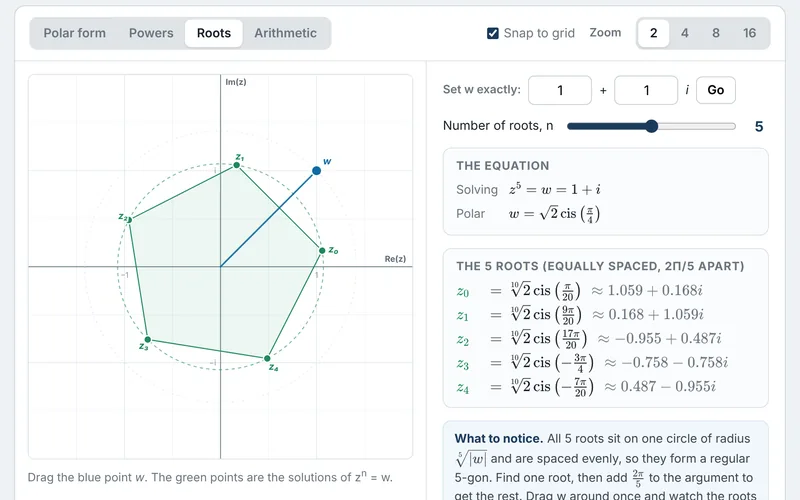
Argand diagram playground
For Specialist complex numbers. Drag z around and watch its polar form, its powers and the nth roots draw themselves, plus what adding, multiplying and dividing look like.
Games
Maths you play, on your own or against friends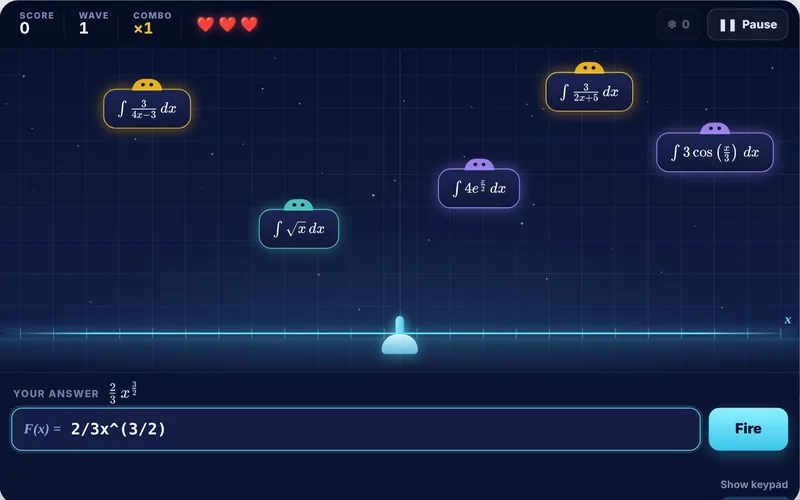
Integral Invaders
Integrals fall towards the x-axis and you shoot them down by picking the right antiderivative (or typing it, for extra points). Easy, Normal and Hard levels, Methods and Specialist modes, bosses, plus a derivatives warm-up.

Vector Golf Tour
Real golf played with vectors, for 1 to 4 players or against the computer. Drag vector cards to dodge water and bunkers, play the complex-number wild card to rotate a shot, and sink the putt by typing the exact vector.
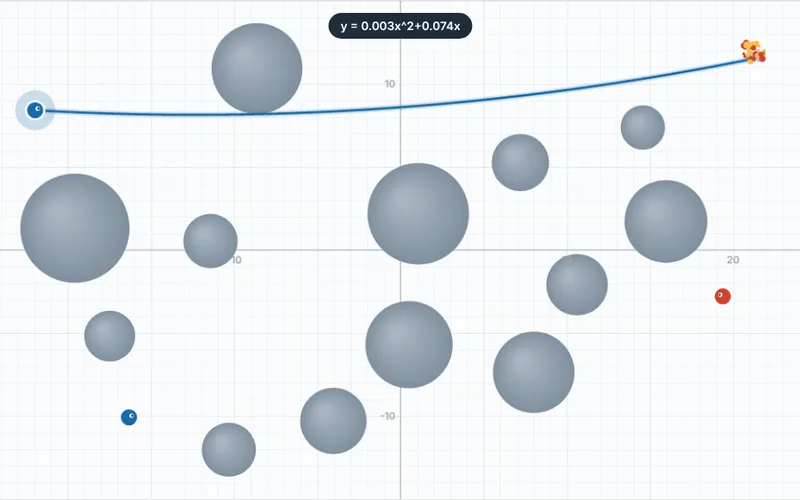
Graph battle
A two-player maths game: type a function and your shot flies along its graph. Bend it round the rocks to hit the other team. Play a bot, a friend on the same device, or online.
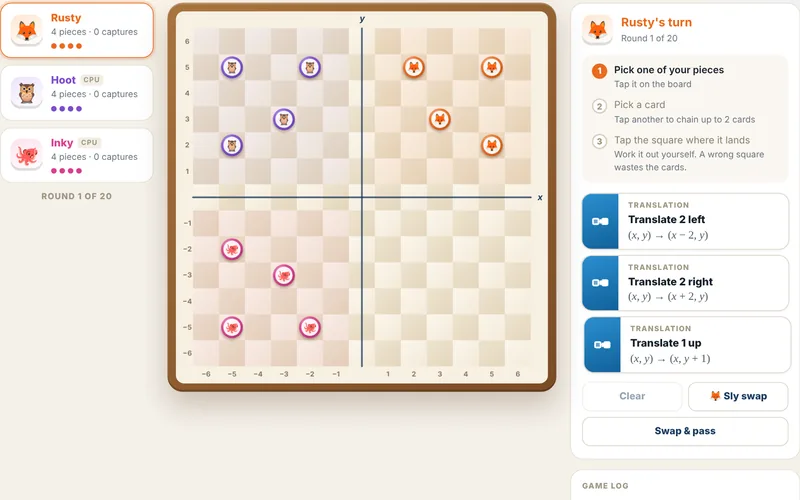
Transform Tactics
A strategy board game for 2 to 4 players: online with everyone on their own phone, pass-and-play, or against the computer. Pick a character, then play reflection, translation and dilation cards to capture everyone else's pieces.
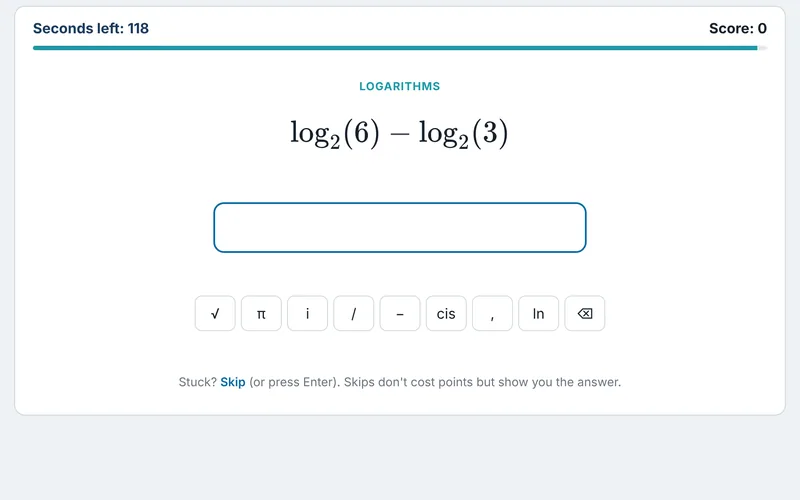
Speed maths
Like Zetamac, for VCE. Race the clock on fractions, exact values, logs, polar to Cartesian, complex arithmetic and more. Pick Methods or Specialist and choose what to include.
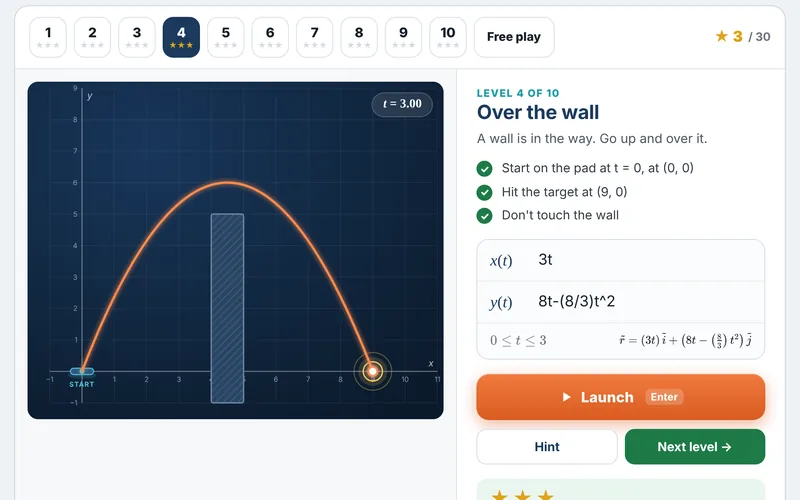
Hit the target
A parametric equations game for Specialist. Type x(t) and y(t), launch, and watch the particle fly. Ten levels: clear walls, arrive on time, use real gravity and loop back to the pad.
Start here
Everything about the subject in one guide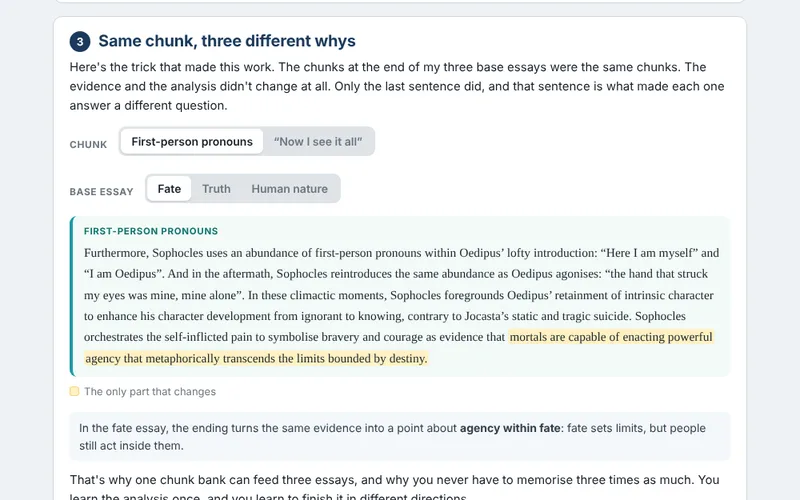
Leonard's guide to VCE English
Everything I learnt on the way to a 49 in English: what exam marks get you what study score, why SACs matter, how to approach each section, and the base-essay and 120-word chunk method I used to prepare Section A.
Exemplars
Annotated pieces that show exactly why they work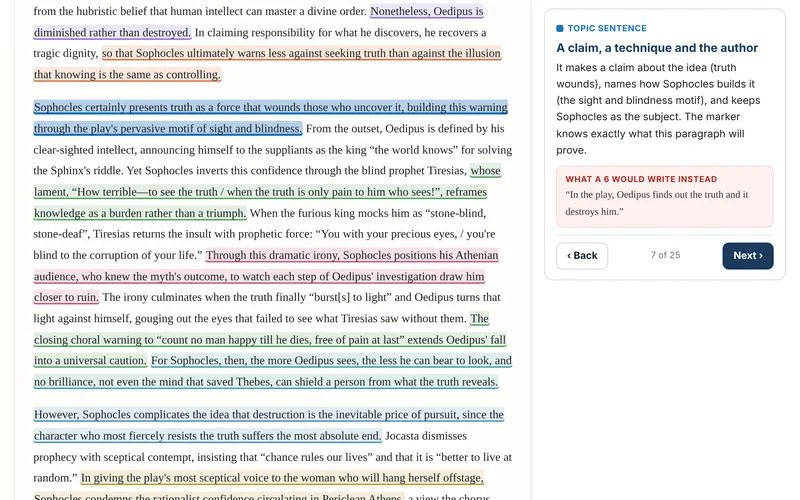
Section A: text response
A full Oedipus the King essay and a plan, annotated line by line: the contention, topic sentences, complex ideas and how each paragraph builds on the last. Read just the spine, or quiz yourself.
Section B: creating texts
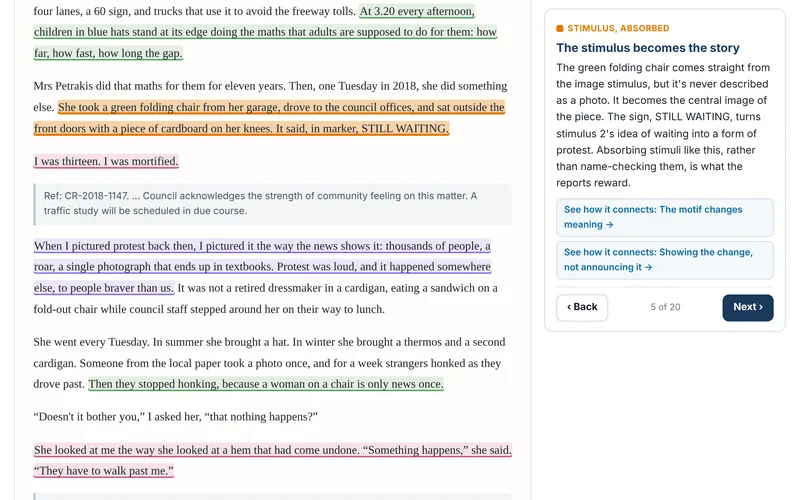
A full piece and a plan with every choice explained: how the title becomes the idea, how the stimulus is used, the motif, the form, the voice and a restrained ending.
Section C: argument analysis
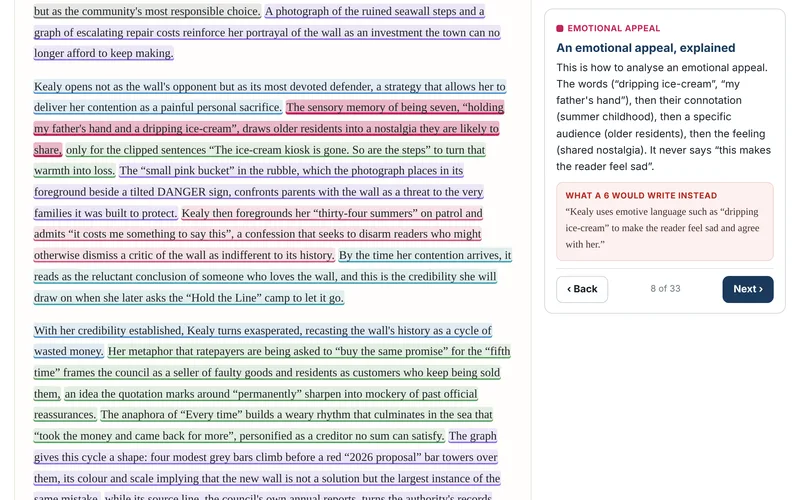
A practice article with visuals, a full analysis and a plan, annotated: audiences and their agendas, one paragraph per argument, emotional appeal explained properly, and links between arguments.
Text guides
Every text on the list, moment by moment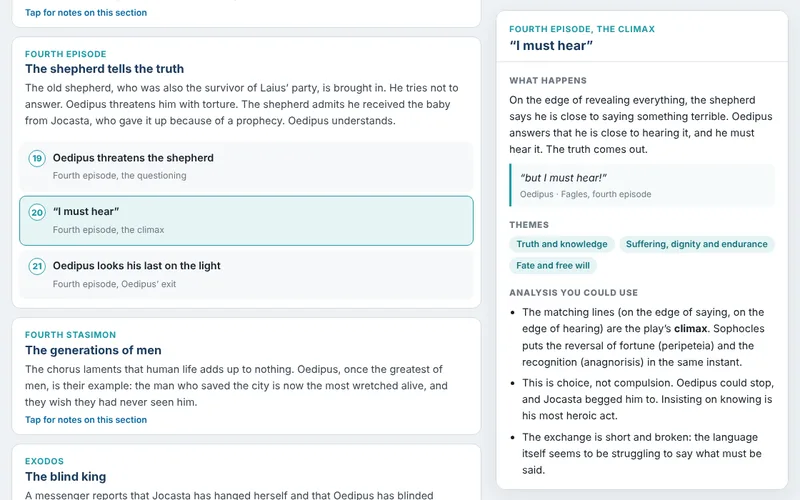
Section A text guide
Every text on the 2026 and 2027 list. Tap an act, scene, chapter or key moment to see the themes, analysis you could use, and the views and values behind it. Full guides to Oedipus the King and Twelfth Night.
Aeneid 12
The 2027 prescribed lines, 1–160 and 793–952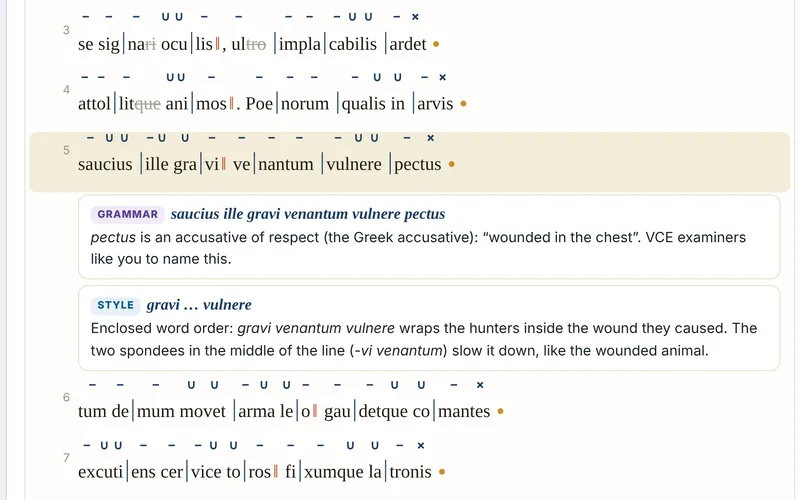
Aeneid 12 study guide
Every prescribed line with notes on style, grammar, context and metre, a translation, the scansion and exam-style questions. Plus the background, themes, techniques and how Section 2 of the exam works.
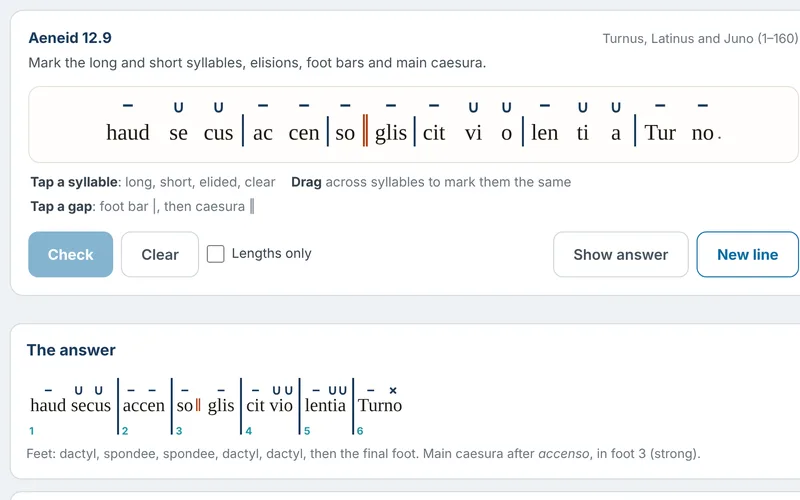
Scan the line
A random prescribed line. Tap or drag to mark the longs, shorts and elisions, put in the feet and the caesura, then see every mistake explained. All 320 lines, checked against an independent scansion.
Translation
Unseen passages the way the exam sets them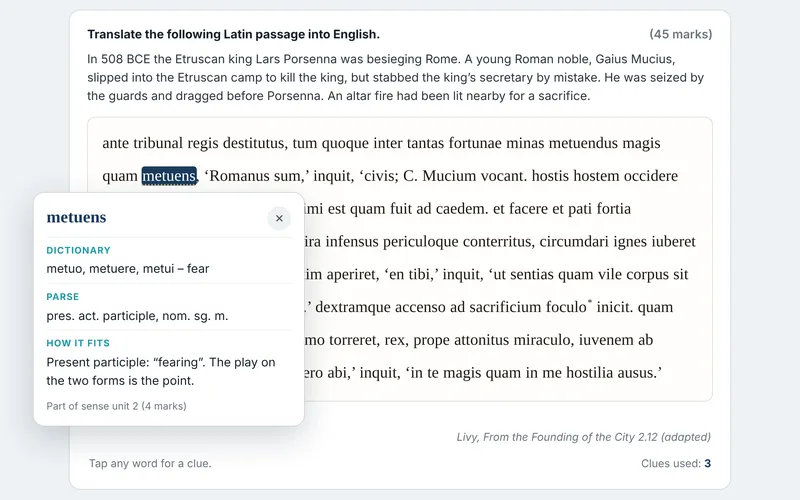
Latin unseens
VCAA-style unseen passages from Livy, Caesar, Cicero, Pliny and Gellius. Tap any word for a clue (dictionary, then parse, then how it fits), then mark yourself against a sense-by-sense mark scheme.
Start here
The whole course, topic by topic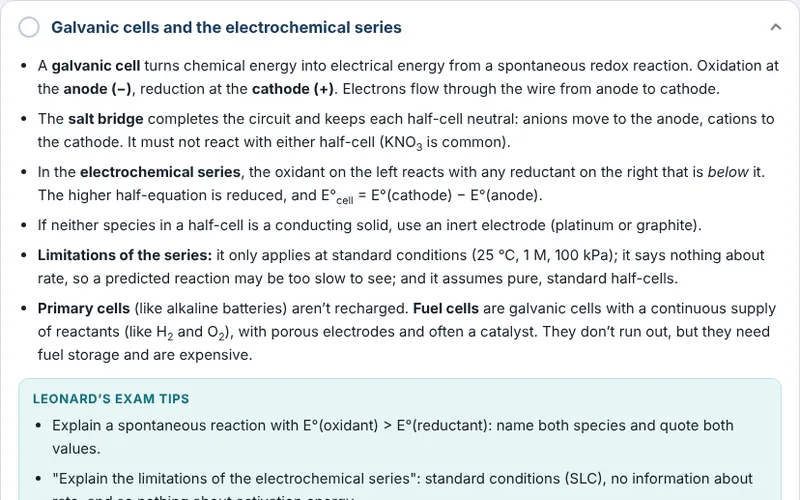
VCE Chemistry study guide
Every Units 3 and 4 topic in plain English, with the mistakes that cost marks and my own exam tips. Search it, and tick topics off as you learn them.
Reference
Everything you look up, in one place you can tap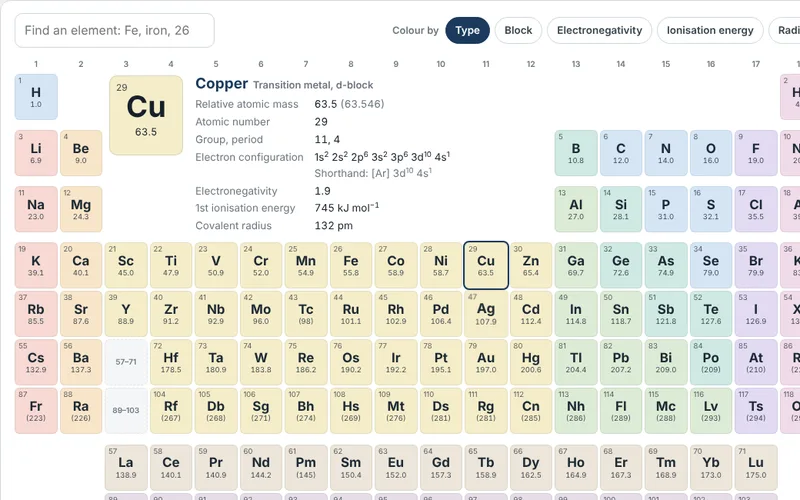
Chemistry data book
Tap any element for its mass, electron configuration and electronegativity, work out molar masses, build a galvanic cell from the electrochemical series, and look up IR, NMR and mass spec values.
Practise
Fresh questions with full working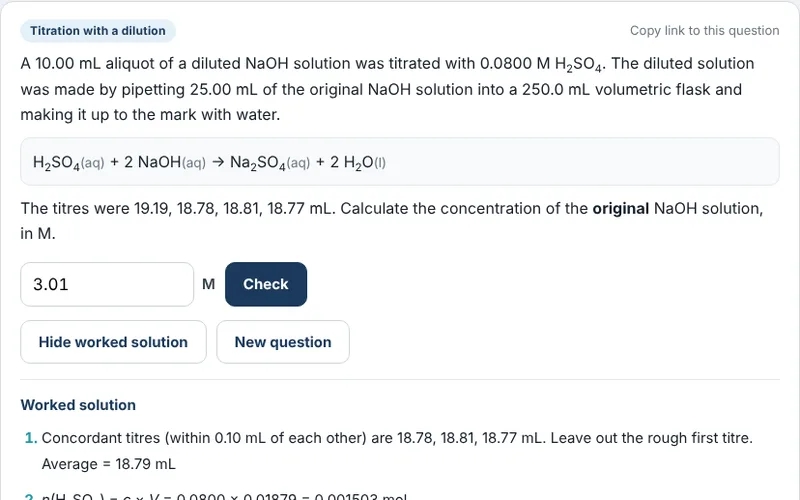
Calculation practice
A new Units 3 and 4 calculation every time: stoichiometry, limiting reactants, gases, titrations, fuels, calorimetry, cells, electrolysis and equilibrium, each with a step-by-step worked solution.
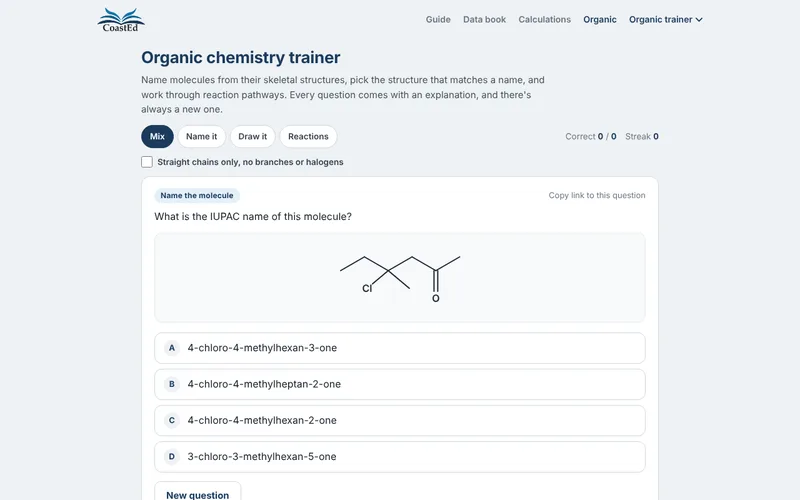
Organic trainer
Name molecules from skeletal structures, pick the structure for a name, and predict products, reagents and reaction types along organic pathways. Every answer comes with an explanation.
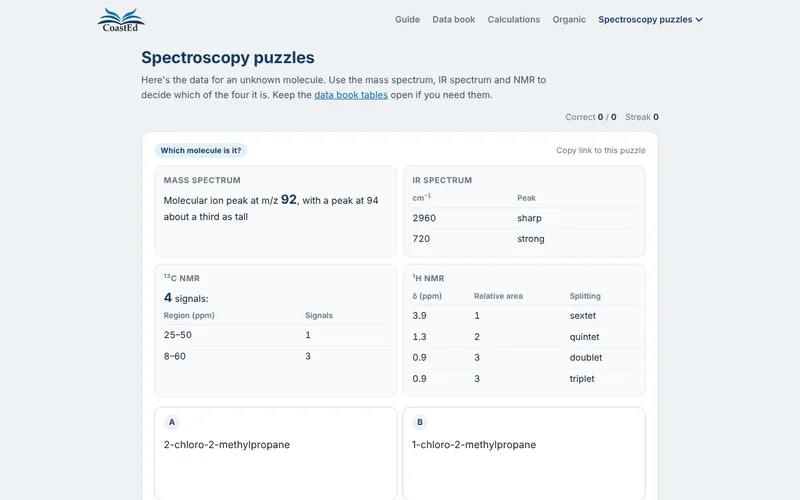
Spectroscopy puzzles
Work out an unknown molecule from its mass spectrum, IR and 13C and 1H NMR data, then see how each clue rules the other options out.
Recording
Double entry, the way the exam sets it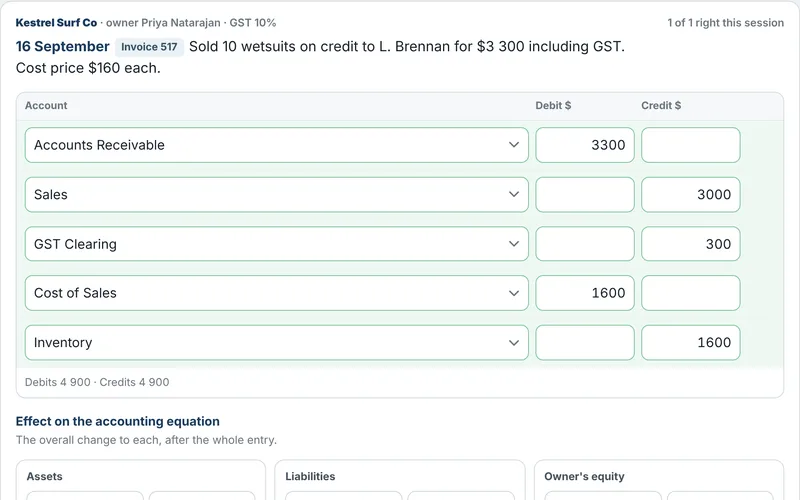
Transaction practice
A new transaction every time for a trading business: sales, purchases, returns, discounts, drawings, assets, loans and GST. Write the General Journal entry and the effect on the accounting equation, checked line by line.
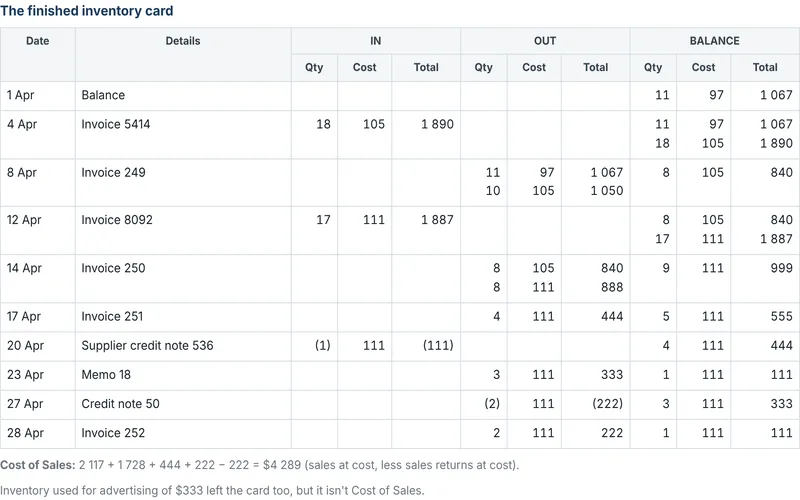
Inventory cards
A month of purchases, sales, returns, drawings and stocktakes for one product. Work out every movement and balance under FIFO or identified cost, then see the finished card.
Reporting
From adjustments to finished reports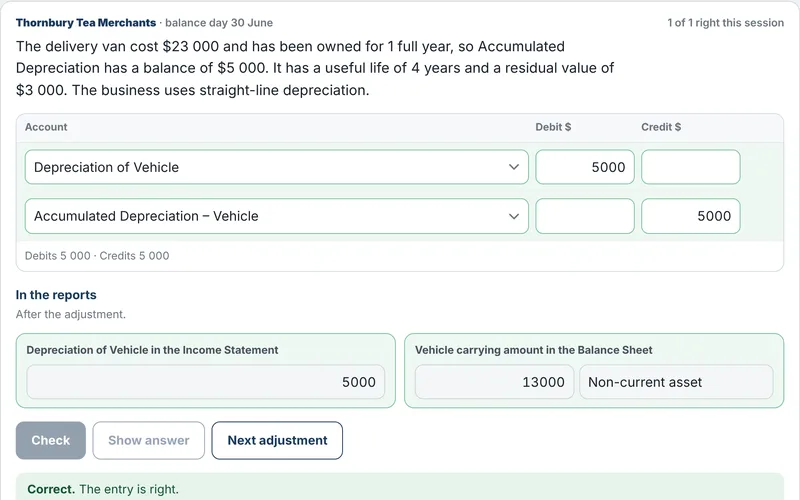
Balance day adjustments
Prepaid and accrued expenses, unearned and accrued revenue, straight-line and reducing balance depreciation, and doubtful debts. Write the entry and the report figures, with the working.
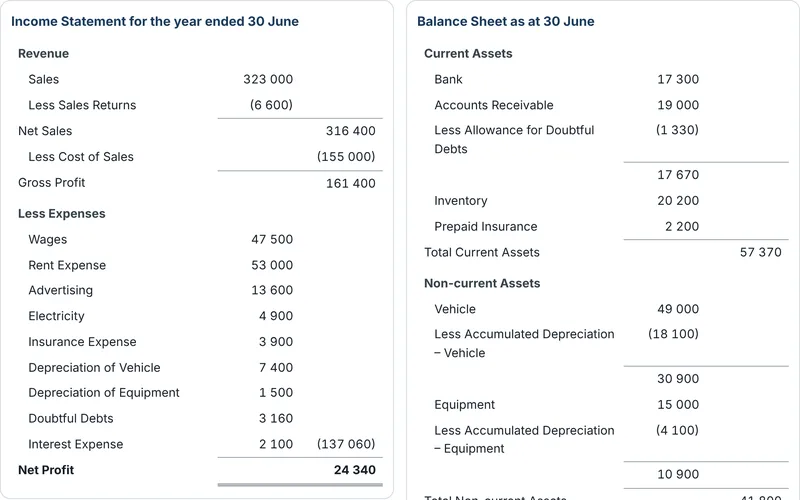
Report builder
Classify an adjusted Trial Balance and work out gross profit, net profit and the Balance Sheet totals, or sort a year's cash flows into operating, investing and financing. Then see the finished reports.
Analysis
Budgets, variances and what the numbers say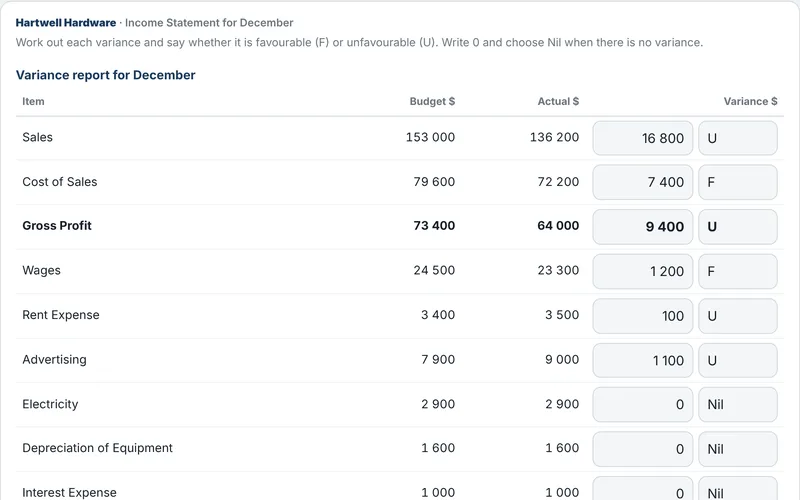
Budgets and variances
Turn a month's budget assumptions into a Budgeted Cash Flow Statement, with receipts from customers, payments to suppliers and GST, or find every favourable and unfavourable variance in an Income Statement.
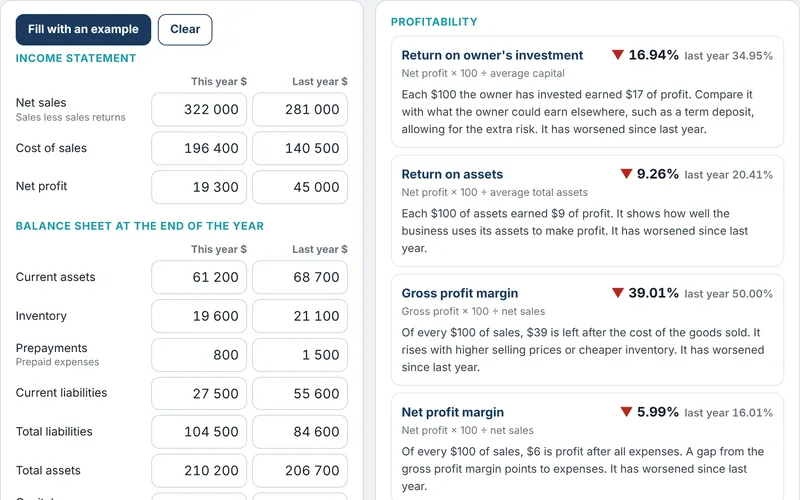
Financial indicators
All twelve indicators in the study design, from return on owner's investment to the debt ratio. Enter two years of figures to see the working, the trend and what each result means.
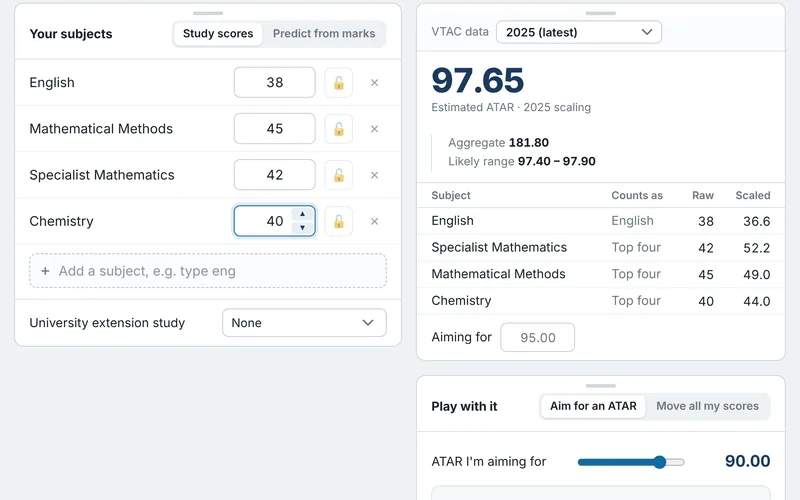
ATAR & study score calculator
Turn exam marks into a study score, and study scores into an ATAR, using VTAC's 2020–2025 scaling and VCAA's grade data.

Exam timer
Keep it open during practice exams. It runs the 15 minutes of reading time, then writing time, with a pacing bar showing how many marks you should have done by now.
School results explorer
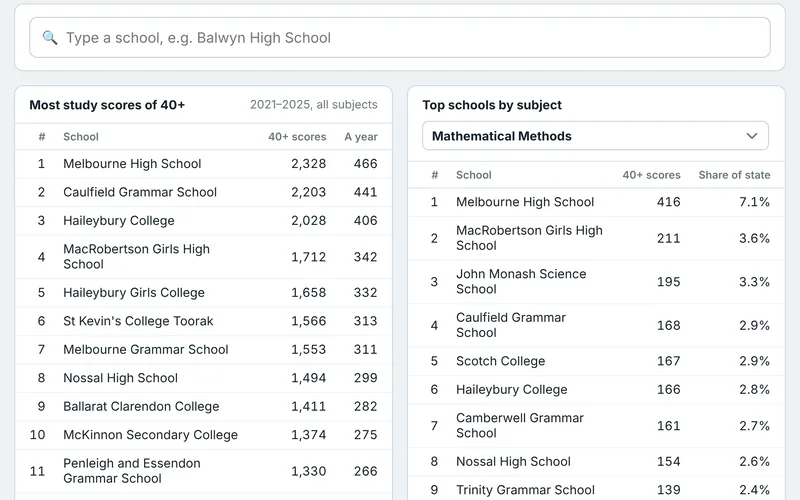
Look up any school's VCE honour roll results: how many 40+ study scores it gets, its strongest subjects, how its top students score and how it compares with similar schools.
How the VCE works
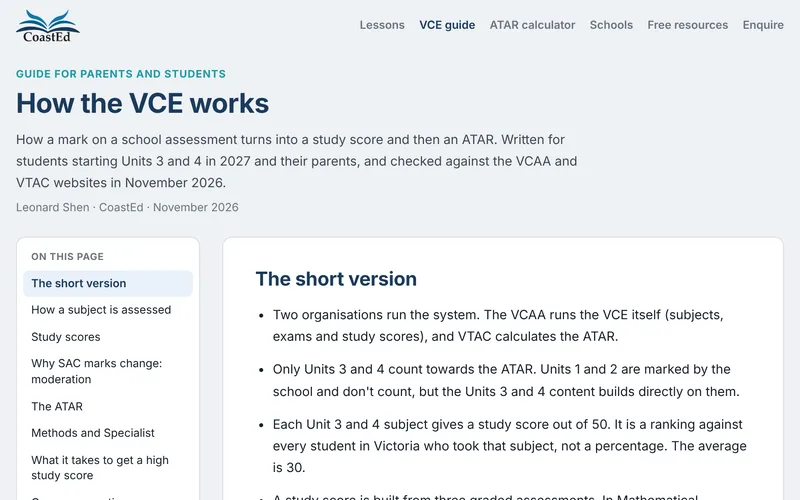
A plain-English guide to study scores, SAC moderation, scaling and the ATAR, for students choosing subjects and for parents.
Found a bug, spotted a wrong answer or have an idea for a tool? Send feedback. It goes straight to me.